
THE MAD QUEEN?

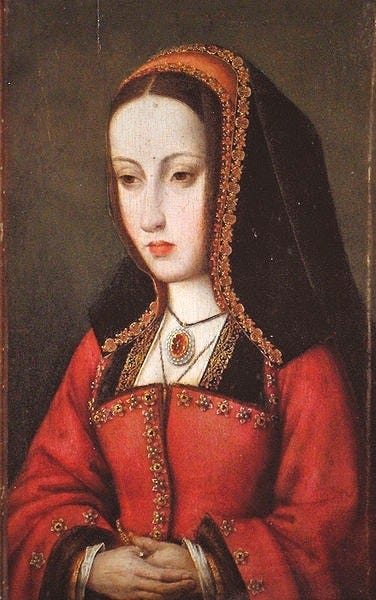
Juana, Queen of Castile was the sister of Katherine of Aragon, and she is known to history as ‘Juana the Mad’ – a nickname she may not have deserved.
Born in 1479, she was the beautiful second daughter of Ferdinand of Aragon and Isabella of Castile, the renowned Catholic monarchs who had united Spain under their joint rule. Juana had two older siblings, Isabella and Juan, and two younger sisters, Maria and Katherine. All were well-educated – Juana was taught languages, music, literature, philosophy, and even law - but Juan and Isabella, the heir and the spare, were brought up to rule, whereas Juana and her younger sisters were destined to make important marriage alliances. In 1496, Juana was betrothed to Philip the Handsome, Archduke of Austria, son and heir of the future Holy Roman Emperor Maximilian I, of the House of Habsburg. Eager to escape the pious rule of her parents, she willingly agreed, and left for Flanders at only sixteen.
Meanwhile, her older siblings were entering their own dynastic marriages. Isabella married first Afonso of Portugal, and then his uncle, Manuel I, while Juan’s marriage to Philip’s sister Margaret of Austria cemented his parents’ alliance with the Habsburgs. Tragedy struck the family in quick succession, however. Juan died mere months after his marriage to Margaret, and his daughter was stillborn shortly afterwards. Less than a year later, in 1498, Juana’s sister Isabella died giving birth to her son, Miguel, who himself would die in July 1500.
These deaths left Juana the unexpected heir to both Castile and Aragon, but she had little support from her husband. Their marriage was strained by Philip’s constant infidelity and his struggle to retain control of his political power amidst the political turmoil in Austria, putting more strain on Juana’s apparently fragile mental health. But, fulfilling her duty to continue her dynasty, she bore several children: Eleanor in 1498, the future Emperor Charles V in 1500, and Isabella in 1501. Shortly after her recognition as heiress by the Castilian Cortes in Toledo and the Aragonese Cortes in Zaragoza in 1502, she had a second son, Ferdinand, in 1503.
In November 1504, her mother, Isabella of Castile, died, leaving Juana queen regnant of Castile. However, her crown was immediately under threat, as her father and husband fought over the right to rule in her name, the stress of which contributed to the difficult birth of her daughter Mary in 1505. Despite her weakened state, Philip insisted that they return from Spain to Flanders. On the journey, the couple were shipwrecked in England, where Juana was briefly reunited with her sister, Katherine of Aragon, now the Dowager Princess of Wales.
When Philip and Juana returned to Castile in June 1506, Ferdinand and Philip secretly agreed to exclude Juana from the government. But in September, after a sudden illness (it was rumoured that Ferdinand had poisoned him), Philip died. Pregnant and alone, Juana was distraught.
Determined to secure their son Charles’s right to the throne, she wanted Philip buried in the resting place reserved for Castilian royalty, the Royal Chapel in Granada. She refused to bury Philip in Burgos, as custom demanded, instead setting off across Castile with the body, making for Granada. This journey gave rise to rumours that she was becoming increasingly insane, with people whispering that she refused to accept that her husband was dead, and that she kept having the coffin opened to talk to, and embrace, his corpse.
Meanwhile, plague and famine were ravaging Castile, and – against her will – a regency council was set up to rule in Juana’s name. In January 1507, heavily pregnant, she was forced to halt her travels in the village of Torquemada, where she gave birth to her sixth child, Catherine. Four of her children were taken from her and sent by her father-in-law, Maximilian, to the court of their aunt Margaret of Austria, governor of the Netherlands, where they would be raised.
In July 1507, Ferdinand returned to Castile, where the plague and famine were abating, and forced Juana to cede her royal powers. In February 1509, she was confined with her remaining children, Ferdinand and Catherine, in the royal palace of Tordesillas, and in 1510, King Ferdinand was named administrator of Castile. Juana’s loyal servants were replaced by his, as rumours of the Queen’s madness continued to circulate. Any hope of rescue from her family was dashed, when her father died in 1516 and her now-grown children Eleanor and Charles came to see their mother in Tordesillas. Although Juana authorised the son she had not seen for ten years to rule alongside her in Spain, Charles would not release her.
Alone in Tordesillas, but for her caretakers and her two children, Catherine and Ferdinand, Juana’s health continued to decline. In 1518, Ferdinand was taken from her. Her three eldest daughters made political matches: Isabella with Christian II of Denmark in 1515, Eleanor with Manuel I of Portugal in 1518, and Mary with Louis II of Hungary in 1521. In 1519, Charles was elected Holy Roman Emperor, while Ferdinand ended up ruling much of Eastern Europe. In 1524, Catherine was taken from Juana to marry John III of Portugal. In 1555, after 46 years in confinement, Queen Juana died alone in the palace of Tordesillas.
The truth about her mental health has long been a source of debate. It has been suggested that she suffered from schizophrenia or depression. There was said to be madness in the family. Her maternal grandmother, Isabella of Portugal, was reputedly affected, although she may have had postnatal depression, isolating herself after the birth of her daughter, Queen Isabella. It has also been credibly argued that Juana’s illness was grossly exaggerated by those around her to discredit her.
Whether or not Juana had a mental illness, her mental stability was shaken by her upbringing in a Renaissance world of power, treachery and brutality,
by her marriage, and later, by her imprisonment, during which she was apparently tortured with rope as a form of therapy intended to preserve her life when she tried to starve herself to death. And no wonder, for her son Charles had ordered that she be kept in isolation and denied news of her children.
It’s a grim tale with no happy ending; Juana was one of the most tragic figures in Spanish history. And yet her story exerts an endless fascination. In 1995, it was the subject of a film, Mad Love, and in 2016, there was another, The Broken Crown. She has been the subject of several history books, most of them academic, and a couple of historical novels, Laurence Schoonover’s The Prisoner of Tordesillas (1975) and C. W. Gortner’s The Last Queen (2008).